Understanding Thyroid Cancer
*Please note: This slide show is not intended to be a substitute for professional medical advice, diagnosis, or treatment. Always consult your doctor about any questions you may have regarding a medical condition.
What is the thyroid gland and what does it do?
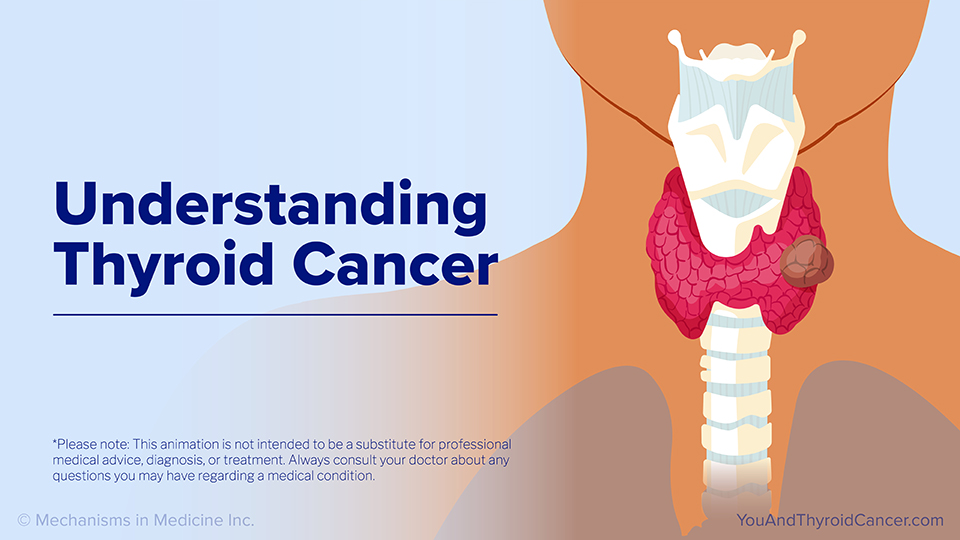
The thyroid is a butterfly-shaped gland in the front of the neck below the voice box that wraps around the windpipe.
The thyroid makes hormones that control how the body uses energy. These hormones affect the heart rate, body temperature, and metabolism.
What are thyroid nodules?
Thyroid nodules are lumps that form inside the thyroid gland. They are quite common. Most are benign, meaning they are not cancer.
Nodules are often found by accident, during an imaging test done for another reason.1
What causes thyroid cancer and who is at risk?
Thyroid cancer results from thyroid cells growing out of control.
One known risk factor is radiation to the head and neck, especially during childhood. But in most cases, we don't know why the cancer developed.2
Can thyroid cancer run in families?
Most thyroid cancers are not inherited and do not run in families. Only a small number of rare thyroid cancers are linked to inherited genetic changes that can be passed down in families.3
What are the types of thyroid cancer?
There are four main types of thyroid cancer.4
Papillary thyroid cancer is the most common. It usually grows slowly and doesn't usually spread outside the neck.
Follicular thyroid cancer is less common. It is more likely to spread outside the neck than papillary thyroid cancer.
What are the types of thyroid cancer?
Medullary thyroid cancer starts in a different type of cell. It can be inherited due to mutations in a gene called RET.
Anaplastic thyroid cancer is rare, but it is the fastest growing and hardest to treat.4
What are the symptoms of thyroid cancer?
Many people with thyroid cancer have no symptoms. Blood tests are usually normal as well. Cancer is often found during a routine exam or imaging done for another reason.1
What are the symptoms of thyroid cancer?
Symptoms may include a lump or swelling in the neck, a hoarse voice, or trouble swallowing. A lump alone does not mean it’s cancer but means more testing may be needed.
How is thyroid cancer diagnosed?
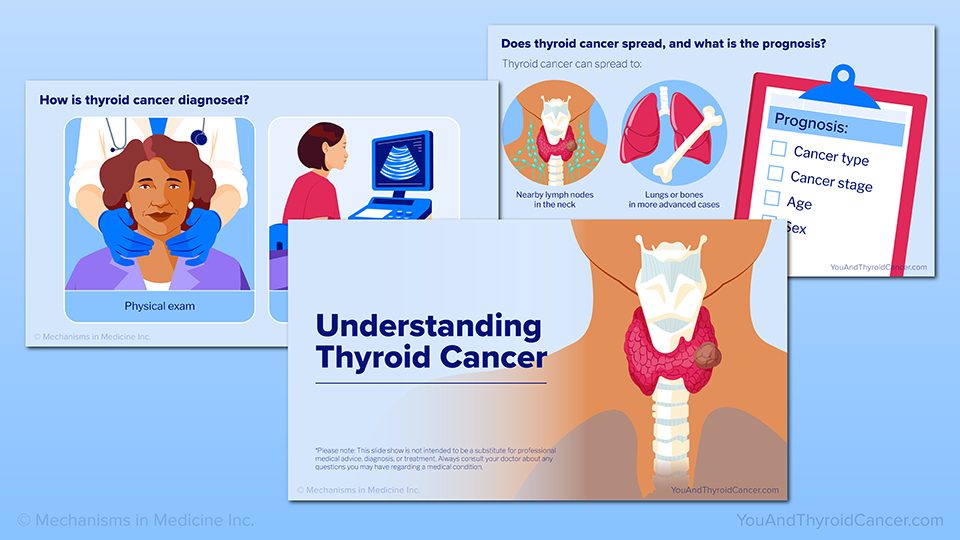
To check for thyroid cancer, usually the doctor starts with a physical exam and an ultrasound of the neck.
How is thyroid cancer diagnosed?
If a nodule looks suspicious, the doctor may order a fine-needle biopsy. This is a safe procedure that is usually done under ultrasound guidance. It helps inform treatment decisions. The doctor uses a thin needle to remove a sample of cells to look at under a microscope.4
What is staging in thyroid cancer?
If cancer is found, doctors use a staging system to describe how far it has spread. Stages range from stage I to stage IV.
Staging uses the TNM system: T stands for the size of the tumor, N stands for whether nearby lymph nodes are involved, and M stands for whether the cancer has spread, or metastasized, to other parts of the body.1
Does thyroid cancer spread, and what is the prognosis?
Thyroid cancer can spread to nearby lymph nodes in the neck. In rare, more advanced cases, it can spread to the lungs or bones.
Most thyroid cancers, especially papillary thyroid cancer, have an excellent outcome. Still, prognosis depends on the type, stage, age, and sex.4,5
How is thyroid cancer treated?
For most patients, thyroid cancers are treated with surgery to remove part or all of the thyroid. The doctor might observe a tumor smaller than 1 centimeter with regular ultrasounds (a process called active surveillance) or treat it with heat in a procedure called ablation.
How is thyroid cancer treated?
Papillary and follicular cancer treatments may also include radioactive iodine (RAI) and thyroid hormone pills.
Medullary cancers are usually treated first with surgery but may require targeted drugs. Anaplastic cancers may require surgery, targeted drugs, radiation, or chemotherapy, depending on how advanced the cancer is.6
The patient and doctor will work together to develop an individual treatment plan.
Why do more women than men get thyroid cancer?
Thyroid cancer is diagnosed in women 3 to 4 times more often than in men.
Much of this difference comes from women getting more imaging, which finds small thyroid cancers. However, examining seemingly healthy thyroid glands under a microscope shows about the same rate of extremely small cancers in men and women. These cancers are so small they are never found or treated.
Who has a more difficult prognosis?
While most patients with papillary or follicular thyroid cancer have excellent outcomes, patients with distant metastases, especially men over 55, have higher rates of recurrence, often need treatments besides surgery, and have cancer that may be more difficult to treat.8
Why is thyroid cancer wrongly called the “good cancer”?
Thyroid cancer, especially papillary thyroid cancer, is sometimes nicknamed a "good cancer" because survival rates are high.
Why is thyroid cancer wrongly called the “good cancer”?
However, treatment can still bring physical, emotional, and financial challenges, and require lifelong monitoring. Some types, like medullary and anaplastic thyroid cancer, can be serious and life-threatening.9
References:
- NIH National Cancer Institute. PDQ® Adult Treatment Editorial Board. Thyroid Cancer Treatment (PDQ®)–Health Professional Version. Last revised: May 9, 2025.
https://www.cancer.gov/types/thyroid/hp/thyroid-treatment-pdq#_1
- Dal Maso L, Bosetti C, La Vecchia C, Franceschi S. Risk factors for thyroid cancer: an epidemiological review focused on nutritional factors. Cancer Causes Control. 2009 Feb;20(1):75-86.
- Lodish MB, Stratakis CA. RET oncogene in MEN2, MEN2B, MTC and other forms of thyroid cancer. Expert Rev Anticancer Ther. 2008 Apr;8(4):625-632.
- Goldenberg D, Givens AK. Thyroid cancer: practice essentials, etiology, epidemiology. Medscape. Last revised: December 2, 2024.
https://emedicine.medscape.com/article/851968-overview
- Chen DW, Carr G, Worden FP, Veenstra CM, Haymart MR, Banerjee M. Survival prognostication in patients with differentiated thyroid cancer and distant metastases: a SEER population-based study. Thyroid. 2024 Jul;34(7):837-845.
- Lee K, Anastasopoulou C, Chandran C, Cassaro S. Thyroid cancer. 2023 May 1. In: StatPearls [Internet]. Treasure Island (FL): StatPearls Publishing; 2026 Jan–.
- LeClair K, Bell KJL, Furuya-Kanamori L, Doi SA, Francis DO, Davies L. Evaluation of gender inequity in thyroid cancer diagnosis: differences by sex in US thyroid cancer incidence compared with a meta-analysis of subclinical thyroid cancer rates at autopsy. JAMA Intern Med. 2021 Oct 1;181(10):1351-1358.
- Suteau V, Munier M, Briet C, Rodien P. Sex bias in differentiated thyroid cancer. Int J Mol Sci. 2021 Nov 30;22(23):12992.
- Papaleontiou M, Haymart MR. Too much of a good thing? A cautionary tale of thyroid cancer overdiagnosis and overtreatment. Thyroid. 2020 May;30(5):651-652.